
What are Cultural Probes? Invented in 1999 by Gaver, Dunn and Pacenti, cultural probes are a category of research instruments, usually consisting of (i) a package of “craft-worthy” materials and tools (e.g. stickers, sticky notes, maps, cameras, voice recorders); and (ii) a collection of prompts Participants respond to the prompts by creating with, or remixing, the provided materials, and return the created/altered materials to the researchers for analysis.
Insights are opened up by this alternative approach to knowledge construction – knowledge by doing – which traditional research can sometimes struggle to reveal.
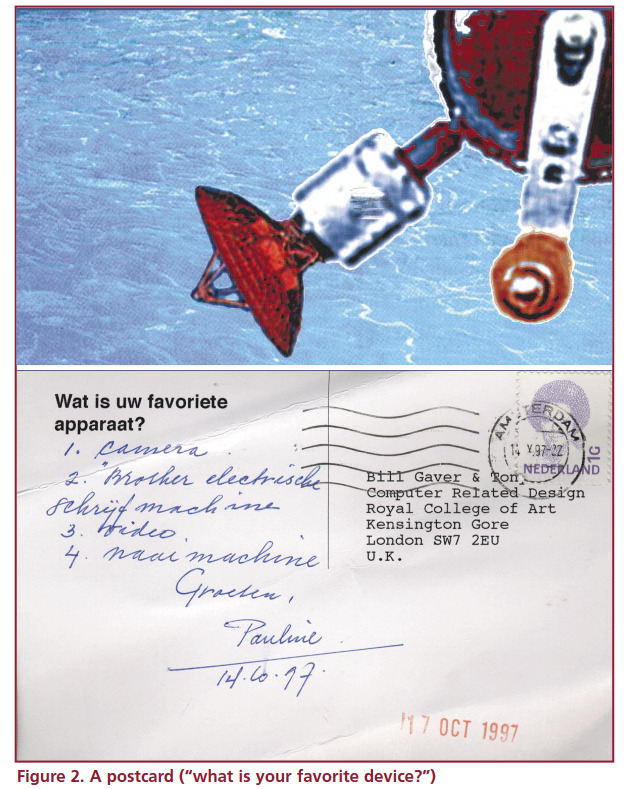
Two probe studies can have needs as different as night and day, so there isn’t a single right way to do a probe. But as Gaver et al. suggest, and this article summarises, probes aim to elicit interesting, surprising, and inspiring responses, and seek to guide the participant’s engagement without dominating it.
Cultural probes do not have to inquire about facts alone (and usually don’t!), but also delve into the speculative (what could be and what one desires), and the procedural (how one does life – the very act of making something can often capture ways of doing). This is effective for painting a portrait of social phenomena which can’t be measured on a scale but can be mapped in a collage of lives and practices.
They primarily serve design research, where it is common for studies to take methods, ideas, and tools in novel, inventive directions, and in sociological research which similarly embraces knowledge as subjective and constructed.
Cultural probes (in their traditional form) are somewhat married to the physical instruments that they are associated with. Due to the limitations imposed by pandemic lockdowns, many researchers looked into adapting methods to online channels – including cultural probes.
This research continues to be useful to us, since our research is about people who still cannot meet and still connecting virtually, even as the rest of the world resumes their pre-pandemic lives.
Within this context, Golmohammadi and Perchard propose online probes as an adaptation of the cultural probe, wherein researchers supply prompts and instructions, but not materials. Alternatively, the tools/materials are wholly virtual and participant responses are returned digitally (as audio, video, images and/or text).
Participants may still engage with physical tools in their vicinity, but translation to digitally deliverable formats makes this method distinct enough from the cultural probe to have its own name. Moreso than with cultural probes, online probes require careful design of the instruments and their delivery.
Like cultural probes, online probes entail limitations on who can access the tools. This is in exchange for online probes being excellent (ideal, even) for delivery across a highly distributed cohort.
The last of these is what makes the online probe method especially applicable to my research. More posts are pending as I progress with ideation on what form the probe will take.
Leave a Reply